Rankadmain

Ranking on the first page of Google used to be the finish line. In 2026 it is only half of the race. When someone asks ChatGPT or Perplexity a question, the answer arrives as a written summary with a few linked sources, and if your page is not one of them, you are invisible at the exact moment the reader decides whom to trust.
This guide explains how to get cited by ChatGPT and Perplexity using a practical blend of SEO, AEO, and GEO, the three pillars of AI search optimization. You will learn how these engines choose sources, which crawlers to allow, how to write passages that are easy to quote, and how to measure results. If the terminology is new to you, read our breakdown of AEO vs GEO vs SEO first, then come back.
Quick answer: How to get cited by ChatGPT and Perplexity comes down to a few steps: allow their search crawlers (OAI-SearchBot and PerplexityBot), publish pages that open with a direct and self-contained answer, support claims with named statistics and primary sources, use clear question-based headings and FAQ markup, keep content fresh, and test your target questions in each engine on a regular schedule.
Key Takeaways
- The core of how to get cited by ChatGPT and Perplexity is simple: be crawlable first, then relevant, easy to extract, and trustworthy, in that order.
- ChatGPT, Perplexity, and Google AI Overviews each use different crawlers and behave differently, so one generic “AI optimization” plan is not enough.
- Research from Princeton shows that adding statistics, quotations, and source citations can raise visibility in generative answers by up to 40%.
- Blocking the wrong bot in robots.txt is the most common reason a good page never gets cited.
- Measurement is manual at first: run your priority questions in each engine every month and log the results.
What Does “Getting Cited” Mean in AI Search?
In traditional search, success meant a blue link in a ranked list. In AI search, the engine reads several pages, writes a synthesized answer, and attaches references to the pages it relied on. Being cited means your URL appears among those references, and sometimes your brand name is spoken inside the answer itself.
It helps to separate three outcomes. A citation is a linked source beside the answer. A mention is your brand named in the text without a link. A recommendation is the engine actively suggesting you as a solution. Citations, such as ChatGPT citations and Perplexity citations, are the easiest to track and the best place to start, because they create referral traffic and signal that your page was trusted enough to be used.
Google describes a related behavior called query fan-out. According to Google Search Central’s guidance on AI features, AI Overviews and AI Mode may issue several related searches across subtopics before composing a response. The practical lesson is that a single page can be pulled in for many sub-questions, so covering a topic in depth, with each sub-question answered clearly, increases your chances of appearing.
How ChatGPT and Perplexity Decide Which Sources to Cite
Both products use retrieval before generation. First, a crawler-built index or a live fetch finds candidate pages. Second, a language model reads the most relevant passages and writes the answer. Your page must survive both stages. Think of it as five filters:
- Access: the engine’s crawler is allowed to fetch the page.
- Relevance: the page matches the question and its related sub-questions, not just the keyword.
- Extractability: a passage can be lifted cleanly without needing the rest of the page for context.
- Trust: claims are specific, attributed, and consistent with other reliable sources.
- Freshness: the page shows a recent update, especially for fast-changing topics.
The strongest academic evidence comes from the paper GEO: Generative Engine Optimization, published by researchers at Princeton, Georgia Tech, the Allen Institute for AI and IIT Delhi. The authors tested nine content changes across thousands of queries and reported that the best methods boosted source visibility by up to 40%. Their findings highlight that including citations, quotations from relevant sources, and statistics can significantly improve visibility. That is why evidence, not decoration, sits at the center of this playbook.
ChatGPT vs Perplexity vs Google AI Overviews: Key Differences
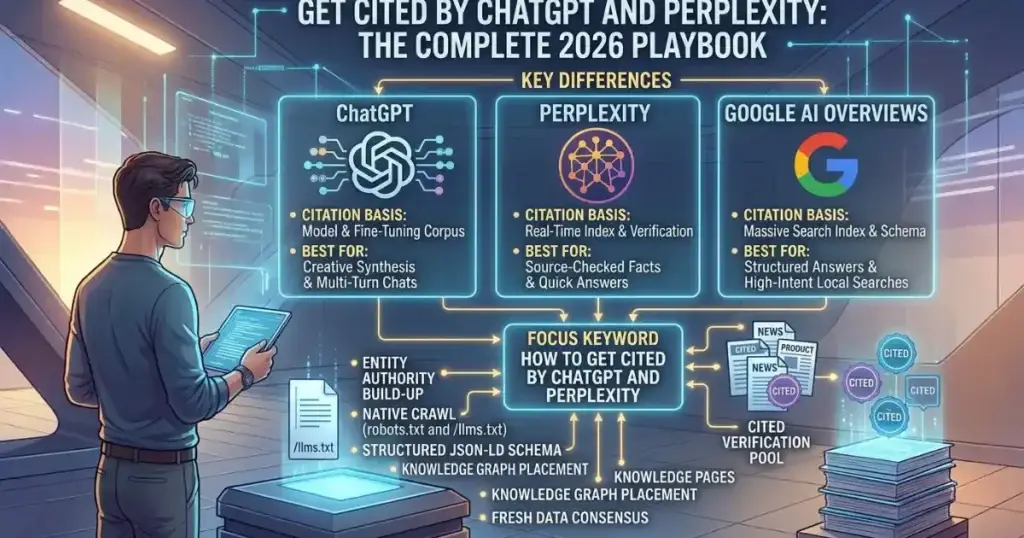
Each platform uses its own crawler and indexing rhythm. Treat the timelines below as practitioner-reported ranges, not guarantees.
| Platform | Search crawler to allow | What matters most | Typical pickup of new content |
|---|---|---|---|
| ChatGPT Search | OAI-SearchBot | Clear, encyclopedic answers with sources | Roughly 1 to 3 weeks |
| Perplexity | PerplexityBot | Fresh, well-cited, reference-style pages | Often within a few days |
| Google AI Overviews and AI Mode | Googlebot | Indexed, snippet-eligible pages with strong SEO basics | Follows normal indexing, often several weeks |
For a newer website, Perplexity is usually the quickest place to see a first citation, while Google AI Overviews tend to reward pages that already perform well in organic search. You can read more about the Google side in our guide to tracking AI Overviews in Search Console.
Step 1: Allow the Right AI Crawlers
If a crawler cannot reach your page, nothing else in this guide matters, which is why access is the first answer to how to get cited by ChatGPT and Perplexity. The good news is that the major AI companies now separate their search bots from their training bots, so you can be visible in answers without opting into model training.
OpenAI’s official crawler documentation explains that OAI-SearchBot surfaces sites in ChatGPT’s search features, while GPTBot is tied to training. The two settings are independent, and OpenAI recommends allowing OAI-SearchBot if you want to appear in search results. Changes can take about 24 hours to take effect. Note that user-initiated fetches such as ChatGPT-User may not follow robots.txt rules.
Perplexity’s crawler documentation recommends allowing PerplexityBot so your pages can be linked in its results, and it separately describes Perplexity-User, which supports user actions. Anthropic explains in its crawler support article that its bots honor robots.txt directives and that restricting ClaudeBot signals your content should be excluded from model training.
A simple robots.txt that welcomes search-focused bots looks like this:
User-agent: OAI-SearchBot
Allow: /

User-agent: PerplexityBot
Allow: /

User-agent: Googlebot
Allow: /

# Optional: opt out of model training only
User-agent: GPTBot
Disallow: /

User-agent: ClaudeBot
Disallow: /
Also check your firewall, CDN, and security plugins. Many “block AI bots” presets quietly block search crawlers too. Review your server logs to confirm that OAI-SearchBot and PerplexityBot are actually visiting, and use the IP lists the providers publish to verify they are genuine.
Step 2: Make Your Pages Easy to Index and Fast to Fetch
Google states that to be shown as a supporting link in AI Overviews or AI Mode, a page must be indexed and eligible to appear in Search with a snippet. The same basic hygiene helps every other engine, and it is a quiet but important part of how to get cited by ChatGPT and Perplexity:
- Publish an XML sitemap and submit it in Google Search Console and Bing Webmaster Tools.
- Keep important content in plain HTML rather than loading it only through JavaScript.
- Avoid accidental noindex tags, login walls, and aggressive pop-ups that hide the main text.
- Use a clean URL, a descriptive title tag, and a self-referencing canonical.
- Connect related posts with descriptive internal links so crawlers can discover and understand your topic clusters.
Internal linking deserves special attention. For example, a reader learning about citations should be able to move naturally to our explainer on Answer Engine Optimization (AEO) and to the comparison of SEO vs. GEO. These links tell both people and machines how your ideas fit together.
Step 3: Open Every Section with a Direct Answer
Answer engines prefer passages that stand on their own. Place a one- to three-sentence answer directly under each heading, then expand with detail, examples, and nuance. This “answer first, explain second” pattern serves skimming readers, featured snippets, and language models at the same time.
Compare two openings for the same heading. A weak version begins with background: “There are many factors in the world of AI search that may influence outcomes.” A strong version answers immediately: “ChatGPT cites pages that its search crawler can access that answer the question in the first sentences and that backlinks with verifiable sources.” “The second can be quoted without any surrounding context, which is exactly what a retrieval system needs.
Turn your headings into the questions people actually type or speak. Instead of a vague label such as “Content Quality,” write “What Content Does ChatGPT Prefer to Cite?” This matches conversational prompts and helps the model map your passage to the question. Our guide on how to create AEO content goes deeper into this format.
Step 4: Add Evidence That AI Engines Can Verify
Vague statements rarely get cited. Specific, attributed facts do. The Princeton study mentioned earlier found that statistics, quotations, and citations improved visibility, which matches what practitioners see in the field. If you change only one thing in your approach to how to get cited by ChatGPT and Perplexity, make it your evidence. Apply the principle like this:
- Name the source and date. Write “Google Search Central states that a page must be indexed and snippet-eligible” instead of “experts say.”
- Use numbers with context. A figure without a source or year is easy to ignore and easy for a model to distrust.
- Link to primary sources. Point to official documentation, research papers, and original datasets rather than to other summaries.
- Add first-hand experience. Screenshots, test results, and small experiments make your page different from the average summary.
- Show the author. A real byline, a short bio, and a visible update date strengthen trust signals.
Be careful not to invent or inflate numbers. Engines compare claims across sources, and a statistic that cannot be verified is more likely to hurt than help.
Step 5: Build Semantic Depth, Not Keyword Repetition
Modern retrieval systems understand meaning, so repeating your focus keyword adds little. What helps is covering the entities and sub-questions surrounding the topic. For this subject, those include crawlers and robots.txt, retrieval-augmented generation, structured data, brand mentions, freshness, E-E-A-T, query fan-out and citation tracking.
Plan a cluster rather than a lone article. A pillar page like this one should connect to supporting pieces such as how to track your rankings on AI Overviews over time, how AI Mode follow-ups appear in Search Console and AEO video content. When each page covers one question deeply and links to its neighbors, your site becomes a coherent knowledge source instead of a pile of disconnected posts.
Use consistent naming. If your brand, product or author appears with the same name across your site, social profiles and directories, models can connect the dots and treat you as a recognizable entity.
Step 6: Use Structured Data Correctly
Structured data does not magically force a citation, and Google is explicit that no special schema.org markup is required for AI Overviews or AI Mode. Still, clear markup removes ambiguity and supports your normal search appearance. Useful types for a guide like this include Article, FAQPage, Organization and Person for the author.
When you add FAQ content, follow Google’s FAQPage structured data guidelines and the definitions on schema.org. Only mark up questions that are genuinely visible on the page, keep the answers factual, and avoid promotional wording. After publishing, test the page with Google’s Rich Results Test and fix any errors reported in Search Console.
Step 7: Keep Your Content Fresh
Perplexity in particular leans toward recently updated, clearly sourced pages. Show a visible “last updated” date and make it honest by actually revising the page. Review your top posts every quarter: replace outdated statistics, add new official documentation, remove broken links and refresh screenshots.
For fast-moving topics like AI search, a monthly check is realistic. Note every material change in a short changelog at the bottom of the post, which also helps readers see why they can trust the page.
Step 8: Build Off-Site Signals
AI engines learn about brands from more places than your own domain. Practitioners report that mentions on forums, video platforms, review sites and reputable publications can influence which brands appear in answers, although the strength of this effect varies by engine. Build real presence rather than chasing links:
- Answer questions helpfully in communities where your audience already asks them.
- Publish short videos that explain one concept clearly, with captions and transcripts.
- Earn mentions by sharing original data, tools or case studies that others want to reference.
- Keep your Google Business, LinkedIn and other profiles consistent with your website.
Step 9: Track Your Citations
You cannot improve what you do not measure, and tracking is the last part of how to get cited by ChatGPT and Perplexity. Start with a simple monthly routine:
- Write 15 to 20 prompts your readers would genuinely ask, including long conversational versions.
- Run each prompt in ChatGPT, Perplexity, Google AI Mode and any other engine your audience uses.
- Record whether your domain is cited, which page appeared, and which competitors were cited instead.
- Check Google Analytics referral reports for chatgpt.com and perplexity.ai sessions.
- Review impressions and clicks in Search Console to see how your pages perform in Google’s AI experiences.
If you prefer to automate parts of the routine, you can connect Claude to spreadsheets and publishing tools, as shown in our tutorial on connecting Claude to Google Sheets, Slack and WordPress. Results vary between runs because AI answers are not fixed, so look for trends over several weeks rather than reacting to a single test.
Common Mistakes That Prevent Citations
- Blocking all AI bots with a blanket rule that also stops search crawlers.
- Burying the answer after long introductions and story-telling.
- Publishing thin summaries that repeat other pages without new data or experience.
- Using unsupported statistics with no source, date or context.
- Ignoring updates, so outdated information sits on important pages for years.
- Over-relying on schema, expecting markup to replace quality content.
- Optimizing for one engine only, when your audience uses several.
Your AI Citation Checklist
Use this GEO checklist before you publish any page you want cited. It sums up how to get cited by ChatGPT and Perplexity in eight quick checks.
- OAI-SearchBot, PerplexityBot and Googlebot are allowed in robots.txt and not blocked by the firewall.
- The page is indexed, in the sitemap and visible without JavaScript.
- Every H2 is a clear question or topic, followed by a direct answer.
- Key claims include named sources, dates and links to primary documents.
- The article has a named author, an update date and consistent brand details.
- Related posts are linked with descriptive anchor text.
- FAQ content is visible on the page and marked up correctly.
- A monthly prompt test and referral check is on your calendar.
Frequently Asked Questions
How do I get my website cited by ChatGPT?
Allow OAI-SearchBot in robots.txt, make sure your pages are indexable, and publish content that answers questions directly with verifiable sources. Then test your target questions in ChatGPT regularly and update pages that are not appearing.
How do I get cited by Perplexity?
Allow PerplexityBot, publish fresh and well-sourced reference-style pages, and keep them updated. Perplexity often picks up new pages faster than other engines, so it is a good place to validate your approach.
Does blocking GPTBot stop ChatGPT from citing my site?
No. OpenAI documents GPTBot and OAI-SearchBot as independent settings. You can disallow GPTBot for training while still allowing OAI-SearchBot so your pages can appear in ChatGPT search.
Do I need special schema markup to appear in AI Overviews?
No. Google states that no special structured data is required for AI Overviews or AI Mode. Standard SEO fundamentals, indexing and snippet eligibility matter most, and FAQ or Article markup can still support clarity.
How long does it take to get cited by AI search engines?
It varies. Practitioners commonly report a few days for Perplexity, one to three weeks for ChatGPT search and several weeks for Google AI Overviews, but none of these timelines are guaranteed.
Is GEO different from SEO?
They overlap heavily. SEO helps pages rank in search results, while GEO focuses on being cited inside generated answers. Strong SEO foundations support both, as explained in our comparison of AEO, GEO and SEO.
Conclusion
Learning how to get cited by ChatGPT and Perplexity is not a trick. It is the result of letting the right crawlers in, answering questions plainly, proving your claims, and keeping your pages current. Start with the checklist above, fix crawler access first, then upgrade your most important articles one by one.
Want to keep learning? Explore more guides in our AI Search and Answer Engine Optimization categories, and see how crawlers like Claude’s fit into the picture in our walkthrough of the Claude AI WhatsApp integration.