Rankadmain
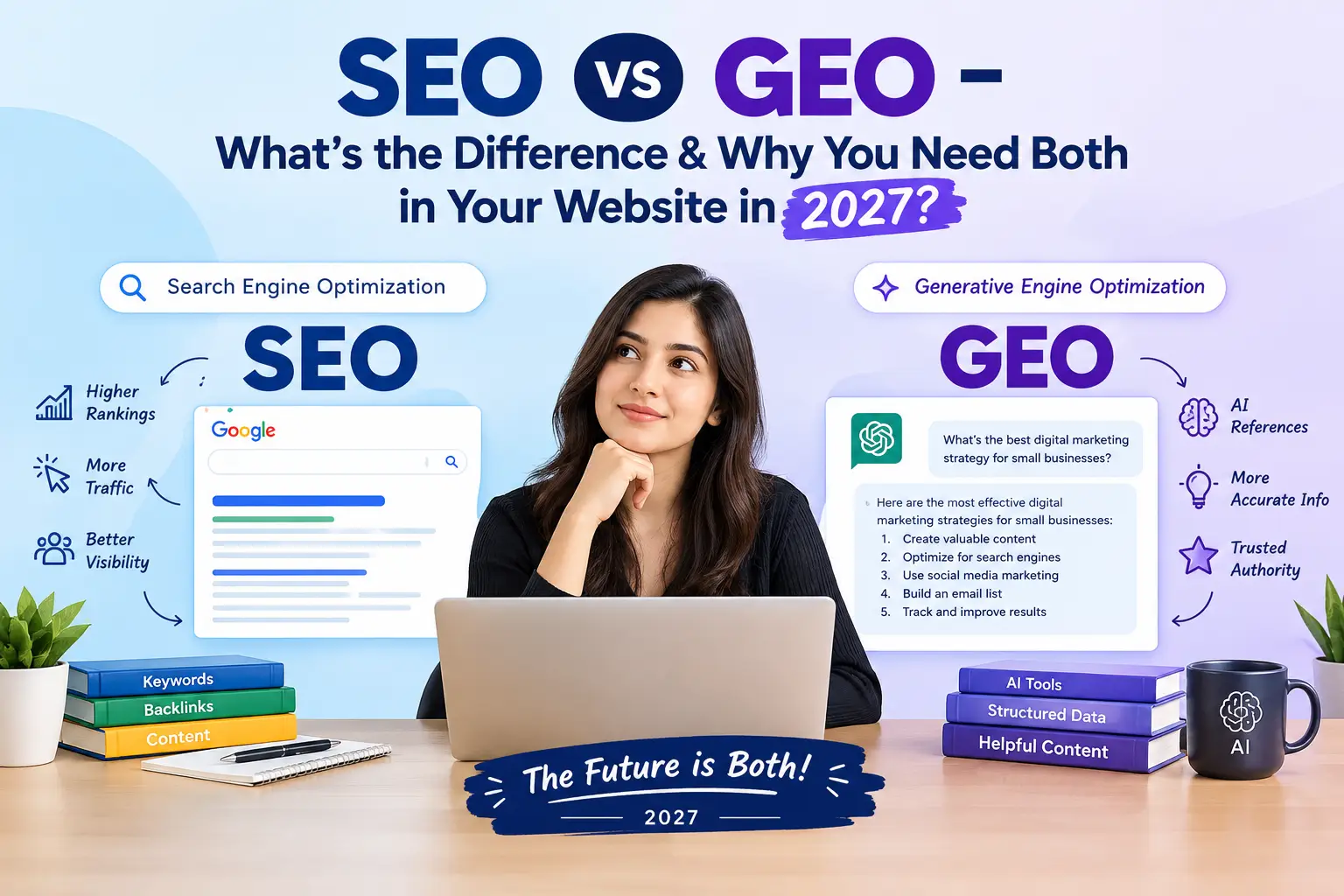
SEO vs. GEO is becoming one of the most important conversations in digital marketing.
For years, businesses focused almost entirely on Search Engine Optimization (SEO) to get their websites discovered through Google. Keywords, backlinks, technical SEO, content optimization, internal linking, and search intent were the foundation of organic growth.
That search environment is changing.
People are increasingly asking questions through AI-powered search experiences and tools instead of relying only on traditional search-result pages. Google itself now includes generative AI features in Search, while users also interact with platforms such as ChatGPT and other AI search systems.
This has created a new optimization discipline commonly called Generative Engine Optimization (GEO).
But there is an important misconception here: GEO does not simply replace SEO.
For most websites, the smarter approach is to understand how SEO and GEO work together, then build content that is useful to people, easy for search systems to understand, and strong enough to earn visibility across different discovery platforms.
Google’s own guidance continues to emphasize helpful, reliable, people-first content rather than content produced primarily to manipulate rankings. (Google for Developers)
So, what exactly is the difference between SEO and GEO?
Let’s break it down.
What Is SEO?
SEO, or search engine optimization, is the process of improving a website so search engines can discover, understand, and potentially rank its pages for relevant searches.
Traditional SEO focuses heavily on search engines such as Google and Bing.
A successful SEO strategy can involve:
- Keyword research
- Search intent analysis
- On-page optimization
- Technical SEO
- Internal linking
- Backlinks
- Website structure
- Page speed
- Mobile usability
- Helpful content
- Structured data
- Topical authority
- Local SEO
- Image optimization
For example, imagine someone searches:
“best website design agency in Oman”
A company targeting that search might create a dedicated service page explaining its website design services, location, process, pricing factors, portfolio, and frequently asked questions.
The goal is to make the page genuinely useful while also making its topic and relevance clear to search engines.
Good SEO isn’t about repeating the same keyword over and over. It’s about creating content that actually answers what people are searching for.
Google specifically advises creators to focus on content that provides substantial value, demonstrates knowledge, and satisfies the visitor rather than producing pages simply because they might attract search traffic. (Google for Developers)
What Is GEO?
GEO stands for Generative Engine Optimization.
The term generally refers to optimizing content so that it has a better chance of being understood, surfaced, referenced, or represented accurately within AI-powered search and answer experiences.
Instead of thinking only about:
“How can I rank this page in Google?”
GEO introduces another question:
“How can my website become a useful, trustworthy source when an AI system generates an answer to this question?”
That’s a different optimization problem.
An AI-powered search system may need to understand:
- What your company does
- What topics your website covers
- Whether your claims are supported
- Who wrote the information
- How trustworthy the source appears
- How different concepts on your website are connected
- Whether your content directly answers common questions
- Whether other reputable sources reference your business or information
This makes clarity, context, authority, and factual accuracy increasingly important.
Google’s current Search documentation also covers AI features as part of the broader search ecosystem, rather than treating them as completely separate from Search. (Google for Developers)
SEO vs GEO: The Main Difference
The simplest way to understand the difference is this:
SEO primarily focuses on visibility in search results. GEO focuses on visibility and representation within generative AI experiences.
They overlap significantly.
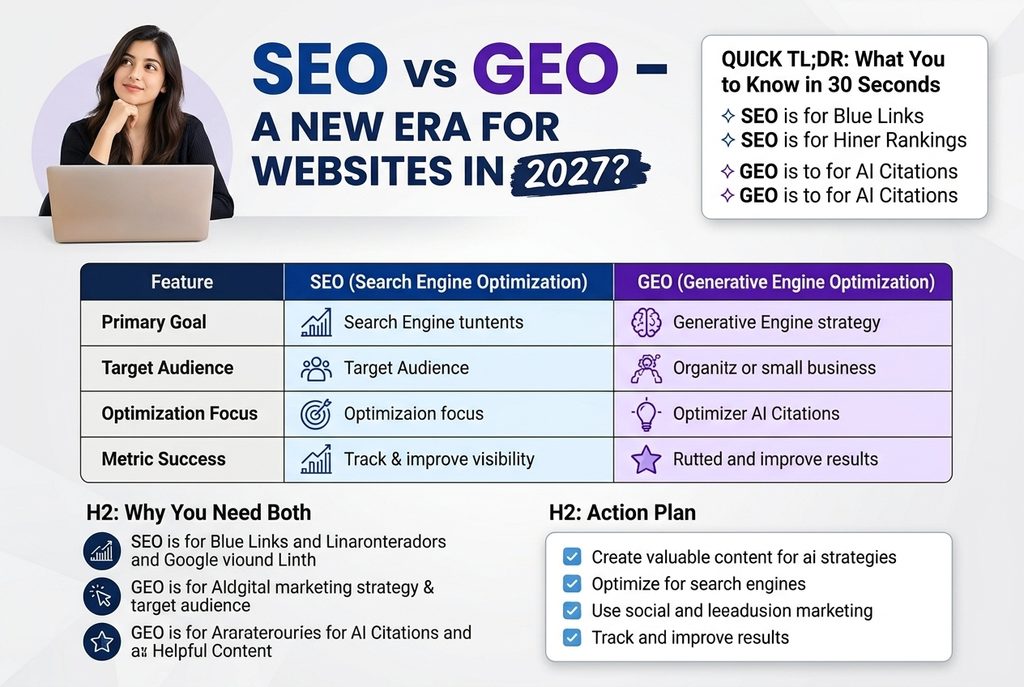
| SEO | GEO |
| Focuses on search engines | Focuses on generative AI/search experiences |
| Targets search queries | Targets questions, prompts, and conversational intent |
| Emphasizes rankings and organic visibility | Emphasizes being understood, surfaced, or referenced |
| Uses keywords and search intent | Uses entities, context, and comprehensive answers |
| Backlinks are important. | Authority and corroboration can matter. |
| Technical SEO matters. | Crawlability and accessible content still matter. |
| Structured content helps. | Clear, extractable answers can help. |
| Search snippets are important. | AI-generated answers and citations are relevant. |
| Strong pages can rank. | Strong sources can potentially be referenced. |
The important part is that these aren’t two completely separate worlds.
A technically inaccessible website won’t become powerful in AI search simply because someone adds a few conversational questions to an article.
Your fundamentals still matter.
Does GEO Replace SEO?
No.
This is one of the biggest mistakes businesses can make when they first hear about GEO.
Imagine you completely abandon SEO and start writing content only for AI platforms.
You could end up with a website that has:
- Poor technical structure
- Weak internal linking
- No clear keyword targeting
- Poor indexing
- Slow pages
- Weak topical organization
- Little authority
- Thin content
- No useful supporting pages
That isn’t a strong foundation.
Google continues to recommend making websites accessible to its systems and creating helpful, reliable content for users. Its documentation also makes clear that SEO itself can be useful when applied to people-first content. (Google for Developers)
So the better strategy isn’t
SEO vs. GEO
It’s:
SEO + GEO + AEO
Where Does AEO Fit In?
AEO means Answer Engine Optimization.
The concept is closely related to GEO, but the terminology is often used differently.
AEO focuses on making content suitable for systems that provide direct answers to questions.
For example:
What is technical SEO?
A well-structured answer might begin:
Technical SEO is the process of improving a website’s technical structure so search engines can crawl, understand, and index its pages effectively.
That’s a direct answer.
The explanation can then continue with examples, details, and supporting information.
This structure can be useful for humans because readers immediately understand the answer.
It can also make the information easier for search systems to interpret.
That’s why AEO, GEO, and traditional SEO often overlap rather than functioning as three completely separate marketing strategies.
SEO vs GEO vs AEO
Think about the three concepts this way:
SEO asks:
How do I make this website discoverable and competitive in search?
AEO asks:
How do I clearly answer the questions my audience is asking?
GEO asks:
How do I make my information useful and understandable within generative AI search experiences?
A strong content strategy can address all three simultaneously.
Why Search Intent Matters More Than Ever
One of the biggest connections between SEO and GEO is search intent.
Suppose someone searches:
“SEO vs GEO”
They may want a definition.
Another person might search:
“SEO vs. GEO: Which should my business use?”
They’re looking for a comparison.
Someone else might search:
“How to optimize a website for ChatGPT”
They’re looking for a practical process.
These are different intents.
A good article shouldn’t simply repeat the phrase “SEO vs GEO” dozens of times.
Instead, it should answer the broader topic surrounding the phrase.
That means explaining:
- What SEO means
- What GEO means
- How they differ
- How they overlap
- What AEO means
- How AI search changes content discovery
- What businesses should actually do
- What mistakes to avoid
This creates a more complete resource.
Why Topical Authority Matters for SEO and GEO
A single article rarely establishes strong authority around an entire subject.
If RankButton publishes one article about SEO and never discusses related topics, the website provides limited topical depth.
But imagine building a content cluster around:
- SEO vs. GEO
- What is GEO?
- What is AEO?
- Technical SEO
- Keyword research
- Search intent
- Topical authority
- Internal linking
- Link building
- Entity SEO
- AI search optimization
- Google Search Console
- On-page SEO
- Content optimization
Now the website starts covering a connected subject area.
This creates a stronger resource for readers and gives search systems more context about what the website is actually about.
Do Backlinks Still Matter With GEO?
Backlinks haven’t suddenly become irrelevant.
A backlink is still a way for one website to reference another website.
But buying hundreds of low-quality links and expecting them to create authority magically isn’t a serious long-term strategy.
A better approach is to earn relevant references through:
- Original research
- Useful resources
- Data
- Expert commentary
- Digital PR
- Industry publications
- High-quality guest contributions
- Useful tools
- Link-worthy guides
The same principle applies to GEO.
If your website makes a useful claim but nobody credible ever references or corroborates your work, that doesn’t automatically make the claim authoritative.
The objective should be to build a web presence that deserves to be referenced.
Content Quality Is More Important Than Hitting 2,000 Words
There’s a common SEO myth that every article needs a specific word count.
It doesn’t.
Google explicitly states that creators shouldn’t write to a particular word count simply because they believe Google has a preferred number. (Google for Developers)
A 700-word article that completely answers a simple question can be better than a 3,000-word article filled with repetition.
For a competitive topic such as SEO vs GEO, however, long-form content can make sense because there are many connected questions worth explaining.
The goal isn’t:
“Write 2,000 words.”
The goal is:
“Give the reader everything they reasonably need to understand the subject.”
That distinction matters.
How to Create GEO-Friendly Content
There isn’t a magic “GEO button” that guarantees AI visibility.
Instead, focus on making your content extremely clear and useful.
1. Answer important questions directly
Don’t hide the answer underneath five paragraphs of introduction.
Give the reader the answer first, then explain it.
2. Use descriptive headings
Instead of:
The Big Difference
Use:
What Is the Difference Between SEO and GEO?
Descriptive headings provide clearer context.
3. Define important concepts
When introducing terminology, explain it in plain English.
4. Add supporting evidence
Where appropriate, use reliable sources, examples, original research, and data.
5. Demonstrate expertise
Show how the information connects to real-world situations.
6. Keep facts accurate
AI systems and search engines don’t benefit from confidently written misinformation.
7. Build topical depth
Create supporting content around the main subject instead of publishing isolated articles.
How to Optimize a Website for SEO, GEO and AEO Together
A practical strategy can look like this:
Step 1: Build a technically healthy website
Make sure important pages can be crawled and indexed.
Use:
- Clean URLs
- Logical navigation
- XML sitemap
- Internal links
- Mobile-friendly layouts
- HTTPS
- Good performance
- Proper canonicalization
Google recommends a good overall page experience and notes that Core Web Vitals are among the aspects its systems use, while also making clear that a perfect score alone doesn’t guarantee high rankings. (Google for Developers)
Step 2: Research topics, not just keywords
Find the questions people actually have.
Step 3: Create comprehensive pillar content
Cover the main topic thoroughly.
Step 4: Create supporting articles
Connect related topics through internal links.
Step 5: Add concise answers
Use short definitions and direct explanations where appropriate.
Step 6: Strengthen authority
Earn relevant mentions, links, and citations.
Step 7: Show who created the content
Author information and transparent expertise can help users understand why they should trust the information. Google specifically recommends making authorship clear where appropriate. (Google for Developers)
Step 8: Measure performance
Use Search Console and analytics to understand impressions, clicks, queries, and pages generating traffic.
Google also provides reporting for its generative AI search features within Search Console. (Google for Developers)
Can GEO Help a New Website Get Traffic?
Potentially, but don’t expect instant results.
A new website has to earn trust and visibility.
Publishing one excellent article doesn’t guarantee rankings, AI citations, or significant traffic.
There are many variables involved, including:
- Competition
- Topic difficulty
- Website authority
- Content quality
- Search demand
- Technical health
- Internal linking
- External references
- Search intent
- Location
- Query type
- User behavior
This is why building RankButton as a real topical website is more sensible than publishing hundreds of random AI-generated articles.
Google’s guidance specifically warns against producing large amounts of content primarily to attract search-engine traffic and emphasizes original, useful, and comprehensive information. (Google for Developers)
Common SEO and GEO Mistakes
Mistake 1: Keyword stuffing
Repeating “SEO vs GEO” in every paragraph doesn’t make an article better.
Write naturally.
Mistake 2: Writing for algorithms instead of people
If the article is difficult for humans to read, optimization has gone in the wrong direction.
Mistake 3: Publishing generic AI content at scale
More articles don’t automatically mean more traffic.
Mistake 4: Ignoring technical SEO
Excellent content cannot compensate for every technical problem.
Mistake 5: Creating no internal links
Your articles should form a connected information structure.
Mistake 6: Making unsupported claims
Don’t say:
“This technique guarantees ChatGPT citations.”
There are no legitimate guarantees like that.
Mistake 7: Chasing every new marketing acronym
SEO, GEO, and AEO are useful concepts, but businesses shouldn’t rebuild their entire strategy every time a new abbreviation becomes popular.
The fundamentals still matter.
The Future of SEO Is Broader Than Google Rankings
Search is becoming more conversational, multimodal,l and integrated with AI.
Google’s current Search ecosystem includes generative AI features, and its Search Console documentation now provides reporting related to generative AI features. (Google for Developers)
That means marketers need to think beyond the traditional blue links.
But the fundamental objective remains remarkably familiar:
Create information that deserves to be found.
If your website provides genuinely useful answers, demonstrates expertise, maintains strong technical foundations, and builds authority over time, you’re preparing the site for multiple discovery environments rather than betting everything on one search format.
SEO vs GEO: Which One Should You Focus On?
For most businesses, the answer isn’t choosing one.
Use SEO as the foundation. Add AEO-style answer structures where they make sense. Build GEO considerations into your content strategy as AI-powered search develops.
SEO helps search systems discover and understand your website.
AEO helps you structure useful answers to specific questions.
GEO expands the mindset toward generative search and AI-assisted discovery.
Together, they create a broader organic visibility strategy.
The mistake would be treating GEO as a shortcut around the fundamentals.
There isn’t one.
Final Thoughts
The search landscape is changing, but that doesn’t mean everything marketers learned about SEO is suddenly obsolete.
SEO vs GEO is better understood as an evolution of search optimization rather than a battle between two completely separate strategies.
Traditional SEO still provides the foundation: technical accessibility, relevant content, search intent, useful pages, internal structure, and authority.
GEO adds another layer: making information clear, trustworthy, contextual, and useful within generative search experiences.
AEO adds another practical layer by structuring content around direct questions and useful answers.
For a website such as RankButton, the opportunity is not to publish endless articles around fashionable keywords. The opportunity is to build a genuine digital marketing resource that people would want to read, bookmark,k and reference.
That’s the kind of content strategy that has a better chance of surviving algorithm changes.
And that’s ultimately what good SEO should have been about from the beginning.
Frequently Asked Questions
Is GEO the same as SEO?
No. SEO focuses broadly on improving a website’s visibility in search engines, while GEO generally refers to optimizing content for generative AI and AI-powered search experiences. The two overlap significantly.
Does GEO replace SEO?
No. GEO should generally be considered an additional layer rather than a replacement for technical SEO, content quality, search intent, and website authority.
What is AEO in digital marketing?
AEO stands for Answer Engine Optimization. It focuses on creating clear, direct, and useful answers to questions users ask through search and answer-oriented platforms.
Does AI-generated content rank on Google?
Google’s guidance focuses on the quality and purpose of content rather than simply whether automation was involved. Google says using automation primarily to manipulate search rankings violates its spam policies, while useful content should be created primarily to help people. (Google for Developers)
How long does SEO take to generate traffic?
There is no universal timeline. A website’s age, authority, competition, content quality, technical condition, topic, and search demand can all influence results. No legitimate SEO strategy can guarantee a specific ranking or traffic number.
How can I prepare my website for AI search?
Start with strong SEO fundamentals, publish genuinely useful content, answer relevant questions clearly, demonstrate expertise, strengthen your website’s topical coverage, and earn credible references. Also monitor your performance through available search analytics and Search Console reporting.