Rankadmain
Search is changing faster than it used to. A few years ago, getting traffic from Google mostly meant ranking high in the traditional search results. Today, people can discover information through featured snippets, AI overviews, conversational search, and generative AI tools.
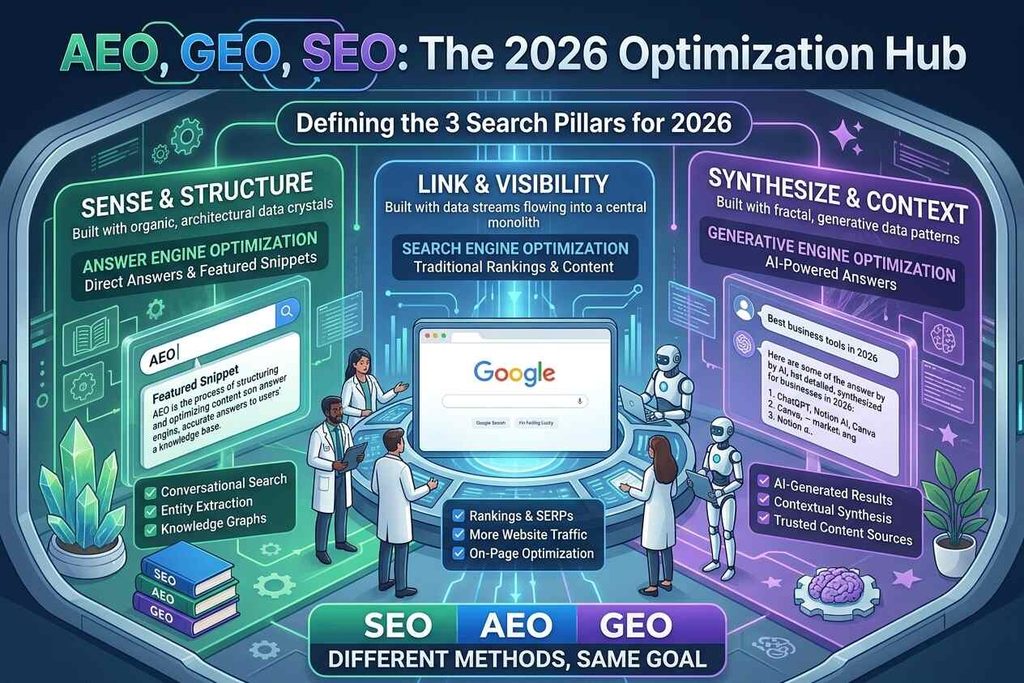
That change has introduced three terms that are becoming increasingly important in digital marketing: SEO, AEO, and GEO.
But what is the difference between them?
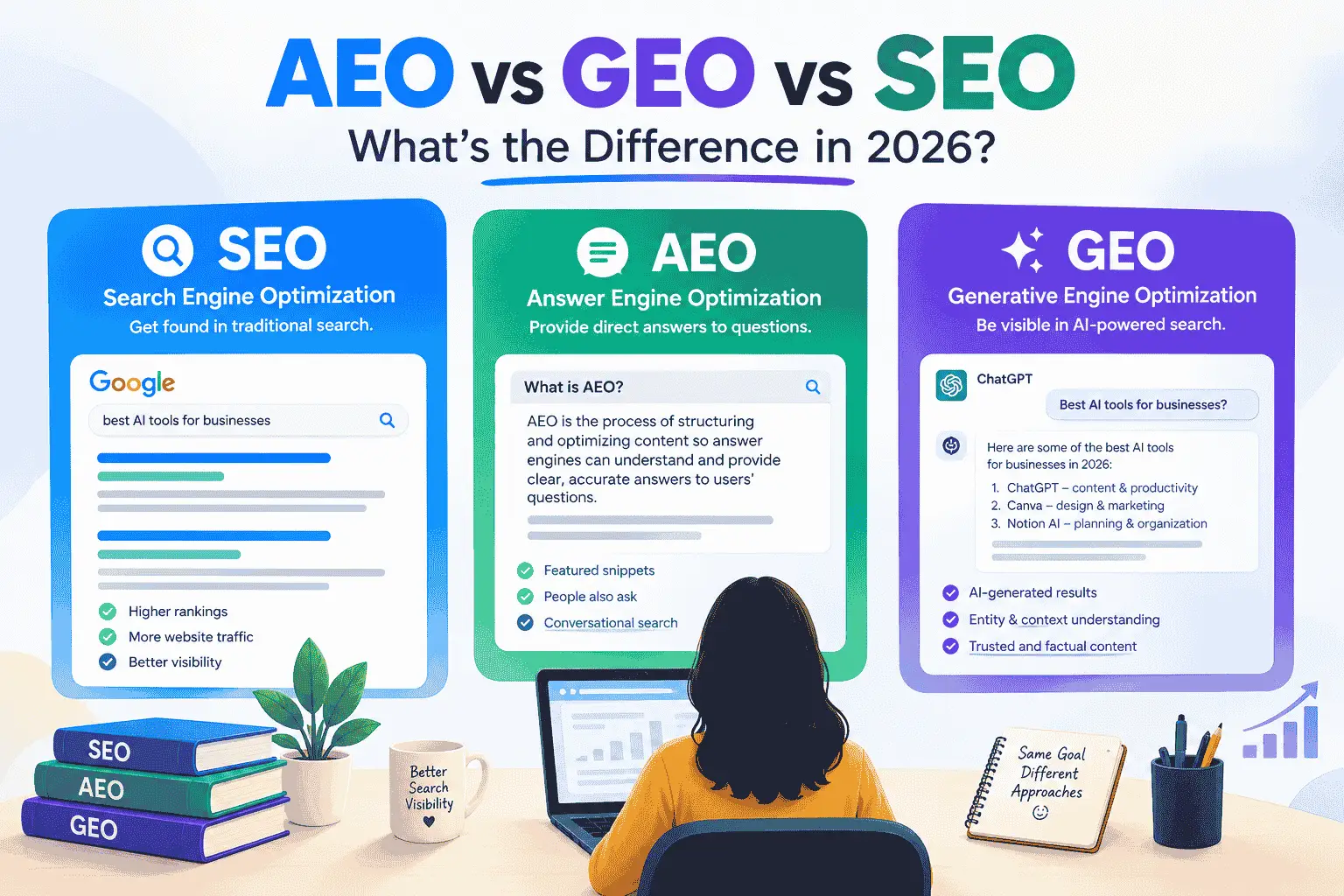
AEO vs GEO vs SEO is not really about choosing one strategy and ignoring the others. SEO focuses on improving visibility in search engines, AEO focuses on providing clear answers to users’ questions, and GEO focuses on making content easier for generative AI systems to understand and potentially use in their responses.
The three approaches overlap, but each has a different primary purpose.
AEO vs GEO vs SEO: What Is the Difference?
The easiest way to understand AEO vs GEO vs SEO is to look at the goal behind each one.
| Strategy search. | Full Name | Main Goal |
| SEO | Search Engine Optimization | Improve visibility in traditional search. |
| AEO | Answer Engine Optimization | Provide direct answers to questions. |
| GEO | Generative Engine Optimization | Improve visibility and usefulness in generative AI experiences |
In simple terms:
SEO helps people discover your website.
AEO helps search and answer systems understand the answers on your website.
GEO focuses on making your content understandable and useful to generative AI systems.
These strategies should not be treated as competitors. For most websites, they work best together.
What Is SEO?
SEO stands for Search Engine Optimization. It is the process of improving a website and its content so search engines can understand it and users can find it through relevant searches.
Traditional SEO includes several areas, including
- Keyword research
- Search intent
- On-page optimization
- Technical SEO
- Internal linking
- Website structure
- Page experience
- Quality content
- Backlinks and authority
- Content freshness
For example, imagine someone searches for:
“Best free AI tools for small businesses.”
A website targeting that search would use SEO to create a useful page around the topic, organize the information clearly, optimize the title and headings, and make sure search engines can crawl and understand the page.
SEO is still important in 2026. The growth of AI search has not made traditional search optimization irrelevant.
Instead, the search environment has become broader.
A strong SEO foundation can help your content become discoverable in traditional search while also giving AI systems a clearer understanding of what your website is about.
What Is AEO?
AEO stands for Answer Engine Optimization.
Instead of focusing only on ranking for keywords, AEO focuses on answering the questions users are actually asking.
Consider a search such as
“What is AEO?”
A page that follows an AEO-friendly approach would answer that question directly before going into a longer explanation.
For example:
AEO is the practice of creating and structuring content so answer-focused search systems can understand and provide useful responses to users’ questions.
That direct answer is followed by additional context, examples, and related information.
This approach is useful because modern search behavior is increasingly conversational. People don’t always search using short keywords. They ask complete questions.
Examples include:
- What is the difference between SEO and AEO?
- How does GEO work?
- How can I optimize my website for AI search?
- Does SEO still matter in 2026?
- What is the best SEO strategy for a new website?
AEO-friendly content should make those answers easy to find and easy to understand.
How Does AEO Differ From SEO?
SEO and AEO overlap significantly, but their emphasis is different.
Traditional SEO might focus heavily on helping a page rank for a search query.
AEO asks another question:
Can this page clearly answer the question behind the search?
That means useful AEO content often includes:
- Clear question-based headings
- Short, direct answers
- Definitions
- Step-by-step explanations
- FAQs
- Lists and comparisons
- Supporting details
- Natural conversational language
AEO does not mean writing extremely short content. A page can provide a detailed, comprehensive explanation while still giving users a direct answer near the beginning of each important section.
What Is GEO?
GEO stands for Generative Engine Optimization.
GEO is associated with the growing use of generative AI and AI-powered search experiences.
Traditional search usually gives users a list of web pages. Generative search can instead synthesize information from multiple sources and present an answer in a conversational format.
That creates a different visibility challenge for publishers and businesses.
It is no longer enough to ask:
“Can my page rank?”
A broader question is
“Can AI systems understand what my content says, recognize its relevance, and potentially use it when generating an answer?”
GEO therefore emphasizes things such as
- Clear and accurate information
- Strong topical relevance
- Consistent terminology
- Well-defined entities
- Original insights
- Credible sources
- Context-rich content
- Easy-to-understand structure
GEO should not be viewed as simply adding more keywords to an article.
Generative systems need context, relationships, facts, and meaning. Good GEO therefore starts with genuinely useful content rather than trying to manipulate an AI system with repetitive phrases.
AEO vs GEO vs SEO: The Key Difference
The biggest difference between AEO, GEO, and SEO is the environment and objective each approach prioritizes.
SEO focuses on search visibility.
The main question is
How can my website become more visible when people search?
AEO focuses on answers.
The main question is
How can my content clearly answer the user’s question?
GEO focuses on generative discovery.
The main question is
How can my content be understood and potentially incorporated into AI-generated answers?
There is considerable overlap between all three.
For example, a well-written article can have strong SEO fundamentals, answer important questions directly, and provide enough context for generative systems to understand the subject.
That is why businesses should usually think about them as complementary strategies rather than completely separate disciplines.
SEO vs AEO vs GEO: A Simple Example
Let’s say you run a digital marketing website and publish an article about AI SEO tools.
With SEO
You might optimize the page around relevant search intent, create descriptive headings, improve internal linking, and make sure the page is technically accessible to search engines.
With AEO
You might include questions such as
What are AI SEO tools?
Which AI SEO tools are best for beginners?
How do AI SEO tools help with content optimization?
Each question would receive a concise and useful answer.
With GEO
You would make the article comprehensive and contextually clear. You could explain what different tools do, compare their capabilities, provide original observations, and support factual claims with trustworthy sources where appropriate.
The result is not three separate articles.
It is one strong piece of content designed to serve users across different search experiences.
How SEO, AEO, and GEO Work Together
One of the biggest mistakes marketers can make is treating SEO, AEO, and GEO as completely independent tactics.
A better approach is to build one strong content strategy and apply the principles of all three.
Think of it this way:
SEO provides the foundation.
Your website needs to be technically accessible, relevant, well organized, and useful.
AEO makes the information easier to consume.
Questions receive clear answers, important definitions are easy to find, and content follows the way people naturally ask for information.
GEO adds another layer of context.
The content should clearly communicate entities, relationships, facts, expertise, and original information so generative systems can better understand the subject.
The boundaries aren’t perfect, and there is no universal formula that guarantees visibility in an AI-generated response. Search and AI systems use complex systems that can change over time.
But creating useful, clear, trustworthy content gives your website a much stronger foundation.
How to Optimize Content for AEO vs GEO vs SEO
If you want one article to perform well across different search environments, start with the basics.
1. Understand Search Intent
Before writing anything, determine what the user actually wants.
Someone searching “SEO vs AEO” probably wants an explanation and comparison.
Someone searching “how to optimize for AEO” wants practical instructions.
The content should match that intent.
2. Answer the Main Question Early
Don’t make readers go through five paragraphs before they find the answer.
Give a concise answer first, then expand on it.
This makes content easier for both people and answer-focused systems to understand.
3. Use Clear Headings
Use descriptive H2 and H3 headings that accurately describe the information underneath them.
Instead of a vague heading such as
“Understanding the Future”
use:
“How Does GEO Differ From SEO?”
The second heading immediately communicates the subject.
4. Build Topic Depth Naturally
Don’t create a 1,500-word article by repeating the same keyword.
Cover related concepts that genuinely help the reader.
For this topic, that might include:
- SEO
- AEO
- GEO
- AI search
- Search intent
- Generative AI
- Answer engines
- AI-generated answers
- Traditional search
- Content structure
This creates topical depth without unnecessary repetition.
5. Make Important Facts Easy to Verify
When discussing statistics, product information, research, or industry claims, use reliable sources and keep information current.
Trust matters more than simply increasing word count.
6. Use Original Information
If every article on the internet says exactly the same thing, your content has little reason to stand out.
Add original examples, practical observations, comparisons, case studies, or useful frameworks when you have something meaningful to contribute.
7. Strengthen Internal Linking
Connect related pages naturally.
For example, an article about AEO vs. GEO vs. SEO could link to separate guides about:
- Technical SEO
- Keyword research
- AEO
- AI search optimization
- Content strategy
Internal links help users discover related information and help search engines understand relationships between pages.
8. Keep Your Website Technically Healthy
Content optimization cannot compensate for serious technical problems.
Make sure important pages can be crawled and indexed, your site has a logical structure, and users can access content without unnecessary barriers.
Can SEO Content Appear in AI Search?
Potentially, yes, but there is no guaranteed method for getting a page included in an AI-generated answer.
AI search systems can evaluate and synthesize information in ways that differ from traditional search rankings.
This means marketers should avoid thinking:
“I need one secret GEO trick.”
A better approach is
Create information that is accurate, useful, well structured, relevant, and easy to understand.
Strong fundamentals remain valuable.
If a page clearly explains a subject, provides useful evidence, establishes context, and answers relevant questions, it has a stronger foundation for being discovered and understood across different search environments.
Should You Focus on AEO, GEO, or SEO in 2026?
For most websites, the answer is not just one.
If you have a new website, start with strong SEO fundamentals.
If your website publishes educational or informational content, add AEO principles so important questions receive clear answers.
If your business wants to adapt to generative search and AI-driven discovery, incorporate GEO principles into the wider content strategy.
In practice, the strongest approach is usually an integrated one.
You don’t need to publish one page for SEO, another for AEO, and another for GEO.
A single high-quality page can support all three.
AEO vs GEO vs SEO: Which One Is More Important?
There is no universal winner.
SEO remains essential for search visibility.
AEO is valuable for question-driven and answer-focused search experiences.
GEO is increasingly relevant as people use generative AI systems to discover and understand information.
The right priority depends on your audience, website, industry, and where your customers are searching.
Rather than asking which one will replace the others, marketers should ask how these approaches can work together.
Final Thoughts on AEO vs GEO vs SEO
The search landscape in 2026 is more diverse than traditional search alone.
SEO, AEO, and GEO are different approaches, but they share a common foundation: useful information created for real users.
SEO helps your website build visibility in search.
AEO helps your content provide direct, understandable answers.
GEO focuses on making content useful and understandable within generative AI-driven discovery.
The most practical strategy is therefore not to abandon SEO and chase every new AI trend. Build a strong SEO foundation, structure content around real questions, provide clear answers, add genuine expertise and context, and keep important information accurate and current.
In other words, AEO vs GEO vs SEO isn’t a choice between three competing strategies. In 2026, they are better understood as complementary parts of a modern search and content strategy.
Frequently Asked Questions
What is the difference between AEO, GEO, and SEO?
SEO focuses on improving visibility in traditional search engines. AEO focuses on providing direct answers to user questions, while GEO focuses on making content easier for generative AI systems to understand and potentially use in AI-generated responses.
Is SEO still important in 2026?
Yes. SEO remains an important foundation for website discoverability. The growth of AI-powered search adds new opportunities and considerations rather than making traditional SEO irrelevant.
Is AEO the same as SEO?
No. AEO and SEO overlap, but AEO places greater emphasis on answering questions clearly and directly for answer-focused search experiences.
Is GEO the same as AEO?
No. AEO primarily focuses on answering user questions, while GEO is concerned with visibility and usefulness within generative AI experiences. Both can benefit from clear, authoritative, well-structured content.
How do SEO, AEO, and GEO work together?
SEO provides the technical and search foundation, AEO helps structure content around questions and direct answers, and GEO emphasizes context, relevance, factual clarity, and information that generative systems can understand.
Can GEO guarantee that my website appears in ChatGPT or AI search?
No. There is no guaranteed GEO technique that ensures inclusion in an AI-generated response. Generative systems use complex processes, and their behavior can change. The best approach is to create accurate, useful, authoritative, and well-structured content.