Rankadmain
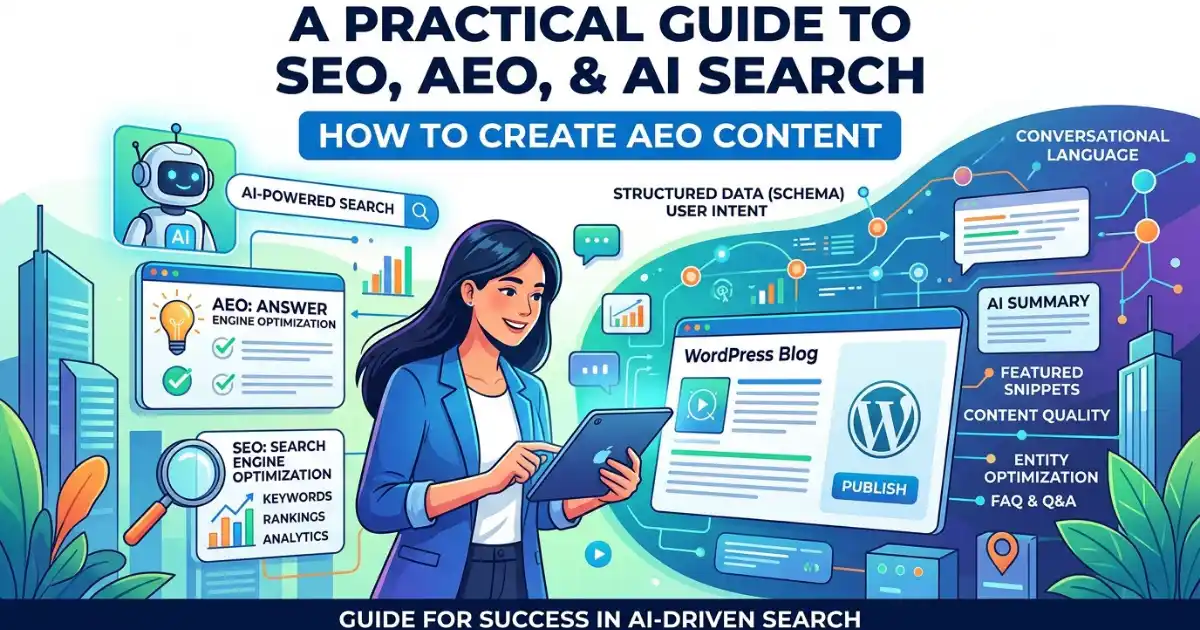
Creating AEO content means developing useful, well-structured information that answers people’s questions clearly and helps search systems understand the topic. The process starts with search intent, relevant keyword research, direct answers, accurate explanations, and practical examples.
As search evolves, businesses need content that works for readers across traditional search engines, answer-focused experiences, and generative AI platforms. That does not mean abandoning SEO or writing separate articles for every AI tool. It means improving the quality, clarity, and usefulness of the content you already create.
In this guide, you will learn how to create AEO content step by step, combine Answer Engine Optimization with SEO and GEO, and measure whether your content is helping your audience.
What Is AEO Content?
AEO content is information created and organized to answer specific user questions clearly and efficiently. It can include blog posts, service pages, product descriptions, tutorials, comparison articles, and frequently asked questions.

For example, someone searching for “How does keyword research work?” probably wants a straightforward explanation before exploring advanced techniques. An effective page answers that question near the beginning and then provides examples, tools, and actionable advice.
Good AEO content typically includes:
- Clear answers to relevant questions
- Descriptive headings and logical sections
- Accurate information supported by credible sources
- Examples that explain how concepts work
- Natural language that matches the audience
- Additional context for readers who want more detail
AEO does not replace traditional SEO. Instead, it adds an answer-focused perspective to content creation. The goal is to help readers find useful information without making them search through unnecessary introductions or repetitive paragraphs.
Why Does AEO Matter for Modern Search?
People now discover information through more than conventional search results. Depending on their needs, they may use featured snippets, AI-powered search features, conversational assistants, or generative AI tools.
These experiences create additional ways for users to find information, but visibility is not guaranteed on any particular platform.
For businesses, the practical opportunity is to create content that addresses real questions, explains important concepts accurately, and offers value beyond a basic summary.
Consider a digital marketing agency publishing an article about technical SEO. A generic article might define technical SEO and list a few common tasks. A more useful resource would explain how to identify crawl errors, check indexability, diagnose internal linking problems, and prioritize fixes.
The second approach gives readers practical information they can apply. It also creates a stronger foundation for search visibility because the page serves a clear purpose.
Google’s guidance emphasizes helpful, reliable, people-first content rather than content created primarily to manipulate rankings. <a href=”https://developers.google.com/search/docs/fundamentals/creating-helpful-content“>Google’s helpful content guidance</a> is a useful reference when developing your content strategy.
SEO vs AEO vs GEO: Understanding the Difference
SEO, AEO, and GEO share several principles, but their primary objectives differ.
| Approach | Main focus | Practical application |
|---|---|---|
| SEO | Search visibility | Improve relevance, technical accessibility, and organic discoverability. |
| AEO | Clear answers | Address questions directly and organize information logically. |
| GEO | Generative AI discovery | Provide meaningful context, accurate information, and useful original insights. |
Search Engine Optimization (SEO) helps people discover relevant pages through search engines.
Answer Engine Optimization (AEO) emphasizes making information easy to identify and understand when users ask questions.
Generative Engine Optimization (GEO) focuses on improving the clarity, relevance, and potential usefulness of content in generative AI experiences.
These approaches work well together. One comprehensive article can follow sound SEO practices, answer common questions, and provide contextual information that generative systems may find useful.
There is no universal technique that guarantees a page will rank first or appear in an AI-generated response.
How to Create AEO Content Step by Step
1. Understand the Search Intent
Before writing, determine what the reader wants to accomplish.
Search intent generally falls into several broad categories:
- Informational: The user wants to learn something.
- Commercial investigation: The user is comparing solutions before making a decision.
- Transactional: The user is ready to take an action, such as purchasing a product.
- Navigational: The user wants to find a particular website or destination.
For example, someone searching for “what is AEO” needs a clear explanation. Someone searching for “best AEO tools” may want a comparison, while someone searching for “AEO consultant” may be evaluating service providers.
The content format should match the underlying need.
Review relevant search results, related questions, and available keyword data before deciding which sections to include. Avoid targeting a keyword simply because it sounds popular.
2. Research Primary, Secondary, and Related Keywords
Keyword research helps you understand the language your audience uses and the subjects they expect your page to cover.
For an article about creating AEO content, potential keyword targets include:
- How to create AEO content
- AEO content writing
- AEO content strategy
- Answer Engine Optimization
- How to optimize content for AI search
- SEO and AEO
- AI search content optimization
These are starting ideas, not verified search-volume figures. Use keyword research tools and current search results to evaluate their relevance, competition, and search intent.
Next, group related queries by topic. Instead of creating a separate article for every minor variation, identify which questions can be answered naturally within one comprehensive guide.
This creates a more coherent article and helps prevent unnecessary duplication across your website.
3. Answer the Main Question Early
One of the simplest ways to improve an article is to give readers the main answer before introducing secondary details.
For example, avoid an introduction that spends several paragraphs discussing the history of search before explaining AEO.
Instead, define the concept in the opening paragraph, explain why it matters, and then expand on the practical steps.
A useful structure is
- Direct answer to the main question.
- Brief explanation of its importance.
- Supporting details and examples.
- Practical instructions or recommendations.
This structure improves the reading experience without requiring every section to follow an identical template.
4. Build a Logical Heading Structure
Headings help readers navigate an article and understand how its sections relate to one another.
Use one clear H1 for the main topic, H2 headings for major sections, and H3 headings for supporting subjects.
For example:
H1: How to Create AEO Content
H2: How to Research Keywords for AEO
H3: Finding Question-Based Search Queries
H3: Grouping Related Keywords by Search Intent
H2: How to Structure Content for Answer Engines
Each heading should accurately describe the information that follows. Avoid inserting keywords into headings when they do not fit naturally.
A clear structure also makes the article easier to maintain as information changes.
5. Add Practical Examples and Original Insights
AEO content should do more than repeat definitions that readers can find on dozens of other websites.
Suppose you are writing about optimizing a service page.
A basic recommendation might say, “Use relevant keywords in your content.”
A more useful explanation would show how to apply that recommendation:
Before: “We provide professional SEO services to help businesses grow online.”
Improved: “Our SEO services help businesses identify technical website issues, improve relevant landing pages, and build a content strategy around their customers’ search needs.”
The improved version communicates more specific information. However, it should only be used when it accurately describes the services being offered.
You can also add original research, verified case studies, practical workflows, screenshots, or observations from genuine experience. Do not invent client results, statistics, or first-hand experiences to make an article appear authoritative.
6. Use Tables and Lists When They Help
Tables are useful when readers need to compare options or understand several related factors.
For example, a guide to SEO tools might compare pricing, supported features, intended users, and limitations. A technical tutorial might use a checklist to help readers complete a process.
Lists can make instructions easier to follow, while short paragraphs help readers find important details quickly.
However, not every article needs a table, and adding formatting for its own sake does not improve content quality. Choose the format that makes the information easier to understand.
7. Answer Relevant Questions With Useful FAQs
Frequently asked questions can address concerns that are not fully covered in the main article.
For an AEO guide, useful questions might include:
- Is AEO different from SEO?
- How do I write answer-focused content?
- Does AEO guarantee higher Google rankings?
- Can AI-assisted content perform well in search?
- How can I measure AEO performance?
Write answers that address the question directly, then include additional context when necessary.
Do not add unrelated questions simply to increase the article’s length. FAQs should complete the topic, not repeat the same information under different headings.
8. Strengthen Internal and External Links
Internal links connect your article to other relevant pages on your website.
For Rankbutton, an article about AEO content could link to related resources covering technical SEO, keyword research, content optimization, and the differences between SEO, AEO, and GEO.
Use descriptive anchor text so readers understand what each link offers.
External links should support important factual claims or direct readers to useful primary sources, official documentation, and relevant research.
Avoid adding links solely to make an article appear authoritative. Each link should serve a clear purpose.
9. Optimize the Technical Foundations
Content quality and technical accessibility should work together.
Before publishing, check that:
- The page can be crawled and indexed where intended.
- The title and meta description accurately describe the content.
- The URL is descriptive and consistent with your site’s structure.
- Images have relevant alt text.
- Internal links lead to the correct destinations.
- The page works properly on mobile devices.
- The content is readable without unnecessary technical barriers.
Use structured data when it accurately describes supported content. Do not assume that schema markup guarantees a featured snippet, rich result, or AI citation.
For further guidance, consult the official <a href=”https://developers.google.com/search/docs/fundamentals/seo-starter-guide“>Google SEO Starter Guide</a>.
10. Measure Performance and Improve the Page
Publishing an article is the beginning of the process, not the end.
Use Google Search Console to review impressions, clicks, click-through rate, and average position for relevant queries. These metrics can help you identify whether the page is becoming more visible and which search terms are generating interest.
For example, if a page receives impressions for relevant questions but few clicks, review whether its title accurately communicates the benefit of visiting. If users arrive through an unexpected query, consider whether the article needs a clearer explanation or an additional section.
Analytics tools can help you understand engagement and conversions. Where available, AI referral data can provide additional insight into visits originating from generative platforms.
Evaluate results over time rather than making decisions based on a few days of data. Rankings fluctuate, and no single metric fully explains content performance.
Common AEO Content Mistakes to Avoid
Several common mistakes can weaken an otherwise useful article.
Keyword stuffing: Repeating the same phrase unnaturally makes content harder to read. Use the primary keyword where relevant and cover related concepts naturally.
Long introductions without an answer: Readers should understand the topic quickly. Introduce the main point before expanding on background information.
Generic explanations: Definitions alone rarely provide enough value for readers who need practical guidance. Add examples, instructions, and meaningful context.
Unverified claims: Do not publish unsupported statistics, fabricated case studies, or promises of guaranteed AI visibility.
Unnecessary content duplication: Creating several nearly identical pages for small keyword variations can waste resources and confuse your content strategy.
Ignoring technical SEO: Even useful content needs an accessible website structure and appropriate indexing configuration to be discovered through search.
The solution is not to follow a rigid formula. It is to create accurate, relevant content that addresses the reader’s needs and is supported by a technically sound website.
Frequently Asked Questions About AEO Content
What is the best way to create AEO content?
Start by identifying search intent, researching relevant questions, and answering the main query clearly. Organize the article with descriptive headings, include practical examples, verify factual claims, and review the page after publication.
Does AEO improve Google rankings?
AEO practices can support a useful, well-structured page, but AEO itself does not guarantee higher rankings. Performance depends on multiple factors, including relevance, content quality, competition, and technical accessibility.
Is AEO the same as GEO?
No. AEO focuses on answering user questions clearly, while GEO focuses on content’s potential usefulness and visibility in generative AI experiences. Both can be incorporated into a broader SEO strategy.
Can AI-generated content rank on Google?
AI-assisted content can appear in Google Search when it meets applicable quality and policy requirements. The important consideration is whether the content is helpful, accurate, original where appropriate, and created for a legitimate user need rather than primarily to manipulate rankings.
How long should an AEO blog post be?
There is no universal word count that guarantees rankings. Write enough to answer the main question, cover relevant subtopics, and provide useful examples. A focused 1,800-word guide may be more valuable than a longer article filled with repetition.
How can I measure AEO results?
Monitor relevant search queries, impressions, clicks, organic traffic, and conversions. You can also review AI referral traffic where reporting is available. These indicators help you evaluate performance, although they do not capture every instance in which a page may be used by an AI system.
Conclusion
Creating effective AEO content starts with understanding what people want to know and giving them useful answers. Keyword research, clear headings, original examples, credible references, and sound technical SEO all contribute to a stronger content experience.
You do not need separate articles for SEO, AEO, and GEO. Instead, build a coherent content strategy that helps people discover your website, understand your information, and take the next appropriate step.
For Rankbutton, the most practical approach is to publish helpful, topic-focused resources, connect related articles through internal links, and improve pages using real performance data.
The goal is not simply to publish more content. It is to create content that answers questions well, earns readers’ trust, and remains useful as search continues to evolve.